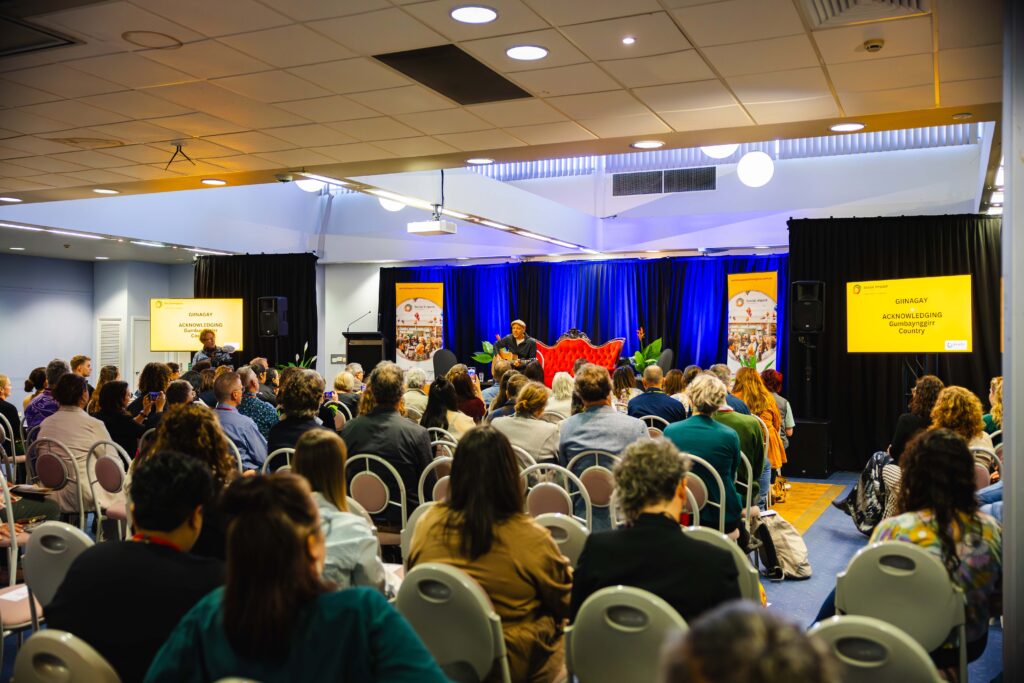
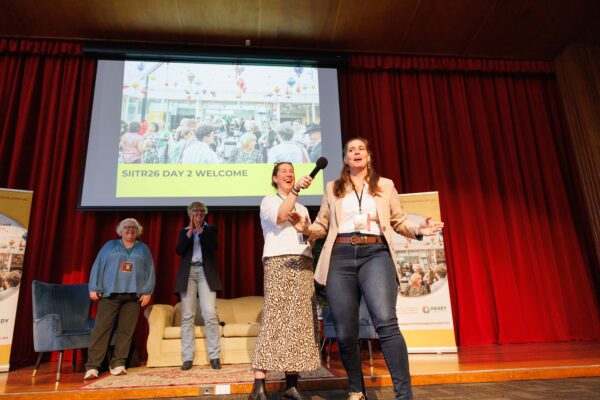
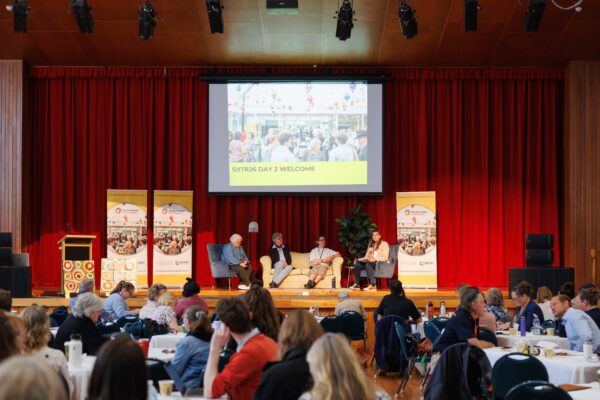
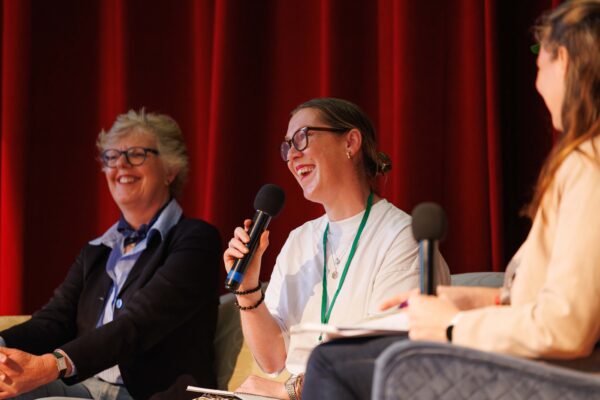
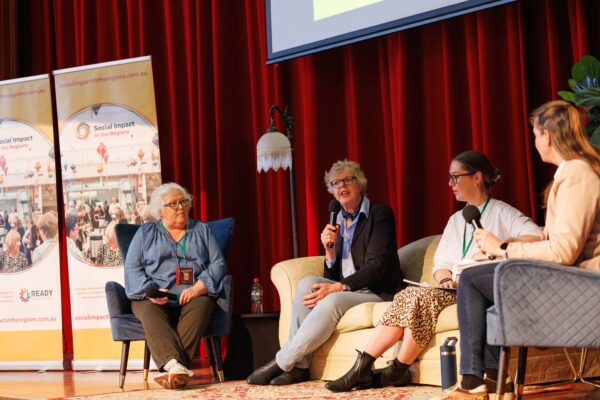
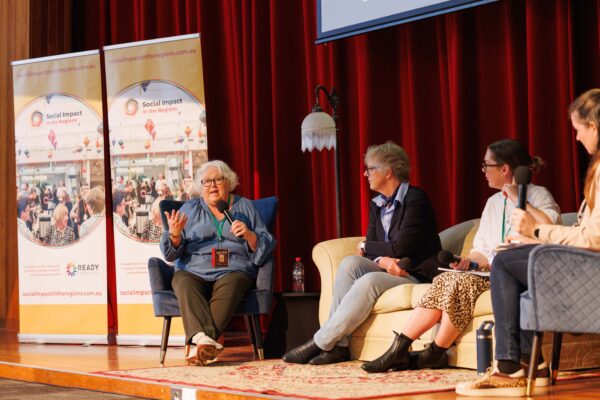
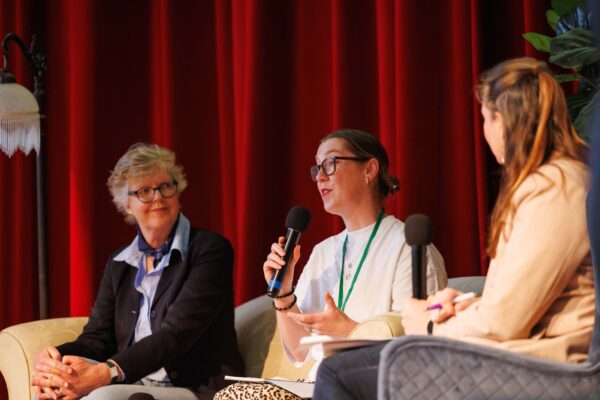
The second panel on Day 2 focused on forms of ‘infrastructure’ featuring Lou Conway from Country Universities Centre, Annabel Cussen from Community Foundations Australia, and Louise Judge from Chinchilla Community Centre, facilitated by Eula Rohan.
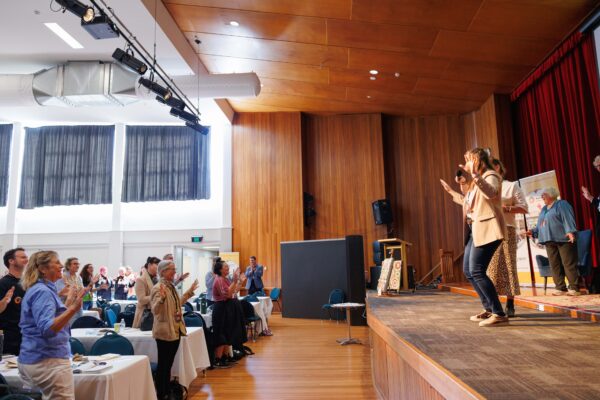
After opening with an exercise to get delegates up and moving, Eula set the scene for the conversation: “We want to explore the underlying needs and the conditions that create the social infrastructure we need for this work to endure in our regional communities. Those conditions aren’t built in the systems; they’re built by the people.”
Eula described the role of ‘social infrastructure’ in sustaining the impact of people. “When most people think about infrastructure, they might think about the buildings, roads, telecommunications towers, and that sort of thing. I want to take this conversation further. What are the types of structures that enable change to happen in regional communities, and importantly enable that change to endure? We’re sitting with local leadership, partnerships, how people come together, and those organisations that support relationships and deepen those levels of trust over time. Our panellists today give us three different windows into these types of structures and infrastructure.”
On the infrastructure
Lou described the Country University Centre (CUC) model that began in Cooma in 2013, founded by Duncan Taylor, to grow a local workforce for the Snowy Hydro scheme. Thirteen years on, it is a federated model of 28 centres, part of 55 nationally, enabling people to study with any tertiary provider from their own community. The model aligns with federal ambition: “Our federal government has an ambition that by 2050, 80% of our community will have a tertiary qualification. In a lot of our rural communities, we’re sitting between 11 and 25. That is our ambition.”
Annabel explained the community foundation model: “A community foundation is a charitable fund that is established within a community or a community of place, community of shared interest. It is locally governed, and it is a vehicle to pool capital that can grow over time. One of the things unique about the community foundation model is the opportunity for communities to direct their capital toward issues, challenges, and gaps within their own community. It’s locally governed and locally stewarded, and the decisions are kept really local.” In explainig in terms of what might be familiar, “We like to think of it as a superannuation fund for a community. Australians are familiar with superannuation. We’re less familiar with the idea of having a superannuation fund that would support your own community.” For twenty years community foundations worked with structures that were not built for them. The federal government legislated the community charity trust last year, giving communities a fit for purpose vehicle to keep capital local.
Louise shared about what makes community centres or neighbourhood centres both the same and unique in each community: “We believe that community centres are the heart of their communities. All community centres or neighbourhood centres respect the needs of the community, and they’re all different because all of our communities are different. Individuals and families come to us daily with a range of needs, and those needs aren’t always what is expected. It might be how we navigate the death of a pet, or fill out these forms, or get food because we’ve got nothing for dinner tonight, or need help and we don’t know where to go. All of those give us information about our community. We have a certain set of skills that assist us, but more than anything, we have knowledge, we know people, we know stuff, and we have amazing relationships. That’s our real infrastructure: those relationships that enable us to turn the bereavement of a pet into how you can get support, and where you can go. Or I’ve got no food and what we can do for you for dinner tonight.”
On what makes it endure
An aspect of infrastructure is that it stays past individual relationships, even as social infrastructure is made up of relationships. Eula explored further to understand “What needs to exist in regional communities for change to actually take hold and endure?” Each piece of infrastructure is also unique for its purpose, as the case for the CUCs for education: “Across our twenty-eight centres, we currently have nearly four thousand people engaged in some type of learning to actually change their future. Fundamentally, education changes lives.”
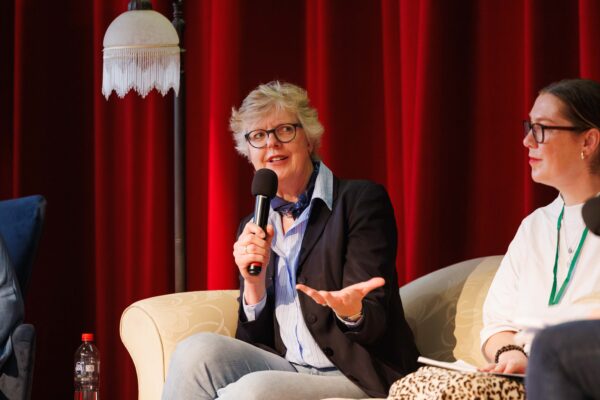
Lou highlighted the connection between physical and relational space: “We hear people say all the time, we came for the space or the service, and we stay for the people and the relationships. That’s the glue.” Across 28 centres there are close to four thousand people engaged in some form of learning. What communities have to get right is social cohesion and opening the door to everybody, and it comes through many small steps rather than one large one.
The other aspect of infrastructure Lue highlighted was its role in ensuring people can stay and be attracted to a place. “What we know is that when people leave to get that education, 80% of them don’t come back. The model of the country university centres, built on what’s called regional university study hub funding from the Commonwealth government, enables people to stay in their community and study everything from engineering to anything from a cert three to a PhD. And we’re engaging with secondary school students to come and use these study spaces, creating the space where people can connect.” The CUC as infrastructure is described as a hub to further connect people to where they want to go. “You’ve got that mingling, that happy collision. But also, we’re doing more work around career development. Some schools are doing great career development, but a lot of people are mid-career or have had a bad experience of education and then wondering how to get to where they want to be. That involves education. We’re becoming a space that connects people to opportunity.”
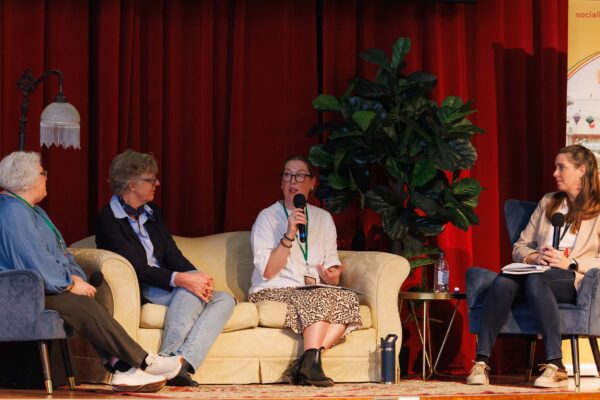
Annabel referenced another aspect of enduring from a community foundatino perspective, that of investing today for future sustained outcomes. “Compound interest is important for how you think about the capital that you have at your disposal. The theory behind a community foundation is that you pull these different capital sources to give you a greater threshold to invest and earn compound interest. A cash balance is earning zero to one percent interest. A pool of capital invested well and stewarded for the long term can start earning six percent to twelve percent to grow in and on itself. We think about this long-term investment within community foundations. The decisions we make now, we want that capital to be stewarded for the next generation and the generation after that.”
The compounding nature of the financial capital is not only financial but results in social capital as well. “There’s also multiple forms of capital. There’s real estate assets and assets that come from communities that volunteer their time. We’re talking about the people power and the social infrastructure that sits around making decisions around this capital. That’s an opportunity for civic discourse and a place to be able to talk about what really matters in a community that wouldn’t have come together unless there was a pool of funds to be able to make decisions over.
As a practical example, Annabel gave the example of a community of 2,500 people in Gippsland, Victoria that has a community foundation established when a nursing home was going to be sold. “The community had an opportunity to hold that capital and say, “Well, we can return this to the community bank. What are we going to do with this capital?” The community committee came together and said, “Well, we need a regional health service.” The community foundation made a decision to establish a rural health service for the region and retain an endowment.” The result is the best attended and best resourced rural health service as well as a growing nine million dollar endowment. “That community’s foundation puts out grants into the community every year and support the community centres, the landcare society and environmental projects. As a result, one of those grant recipients has left a significant gift in a will to the community foundation. Rather than their held assets being acquired by a larger charity or a national charity, they’re going to stay close to home, and that will go back into the community foundation for the next generation and the generation after that. Thinking a little bit differently around how capital can stay in a community, and the community foundation, the deed of trust, the charitable status – that’s the structure that enables that.”
On establishing infrastructure
Eula continued to explore with the panel the approach to how such infrastructure is established in communities. “To get to that stage, there are a lot of steps and building that leaders need to be able to come together. What does it take to seed the idea that we need to come together to change what’s happening in this community?”
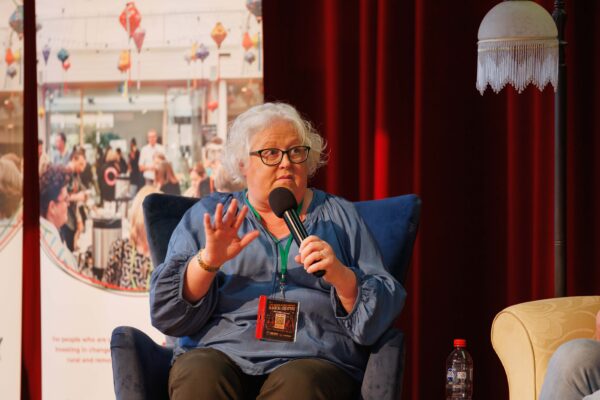
Louise reflected on two examples, first with the Red Earth Community Foundation in Queensland’s Burnett Inland region. “In South Burnett, we had curious minds that wanted to do something different. It took about five years before the Red Earth Community Foundation happened.”
The second example showed the difference of change through catalytic events. “In Western Downs, it was completely different. We had fires, we had floods, we had all sorts of horrible things happen to the broader community, which put everyone on the same page thinking we need to do things differently. We’ve got these relationships which we purposely grew, and we were blessed with the way council initiated that and fostered the development of the relationships and the thinking around what does our whole region need, not this community or that community, but what does everyone need. And it was the same things everyone needs – health services, housing, education, employment. None are unique to any of us, it’s how we then look at them within our regions and decide what we can do and what relationships we need to build to help us go to the next step. . Eventually, Western Downs Futures ended up with more than a hundred people, all decision makers, and very invested in the community, coming together around these common issues, and they’re all interrelated. The next step was to become a real entity, not a thing that sat underneath council. So we had to look at what kind of an entity we might become, asking, ‘How do we afford to become that? What are the next steps?’ It sounds like it wasn’t really much, but it’s been two years of work, and we are now at the step where we have applied for incorporation. We have built an amazing partnership with the John Villiers Trust to support us to go forward and continue to develop into an organisation that can work across the district. Our council is continuing to support us as well. It’s a lot of work, but every single step, if those relationships weren’t there, nothing would happen.”
A follow-up conversation focused on how long change takes and the tension between drivers from external pressures and the need for community trust. Lou reflected on an extreme case of change from the Milan Cathedral. “It took 600 years to build. Your vision and building that takes time. And how do we transfer that between people who are there to lead it and take charge?” Both capacity building and leadership were noted as necessary.
Louise broke this down into relationships. These relationships are more than transactional, and where there are centres with a large number of relationships that can facilitate connections from seemingly random information. “The relationships build trust. They give you skills. They teach you things. Whether it’s what you thought you were going to learn or whether it’s something completely different, you have to be curious and stay open to whatever is going to come next. And learn. Every relationship teaches you something. How many weird things have you learned to do that you did not expect to hear, had never really thought of before? They’ll be those things that fly away in the back of your mind, and one day you will be like, ‘I heard this’ and apply that piece of knowledge or that skill or that connection. Community centres are like that all the time. Most community-based organisations, and I don’t care if you’re talking about a local footy club or senior citizens, are all similar. They are relationship-based with a common interest. It’s shared responsibility and trust between the people involved.
On equity in infrastructure
But ‘community’ is not homogeneous. It is made up of communities within communities based on interests, demographics, and geographies. Lou gave an example of this based on young men with interests in online gaming. “In some of our communities, we are seeing young men not engaging in education. For some of those young people, they’re gaming at home and opting out of education early. They are fabulous at relationships and collaborating internationally. They have an extraordinary range of skills. I was recently in Victoria at a tech school at Wyndham that is leaning into how we enable people to build esports. It’s a three-billion-dollar industry worldwide. How do we build that? How do we see where those skills are?” The question posed was how to leverage the sector to bring young men into learning spaces.
Annabel added that development needs to happen at the speed of trust, without waiting for perfection to start. “There was something said this morning around not letting perfection get in the way of progress. We tend to engineer a perfect solution before we get started. It can hold us up. Many conversations are around getting the right framework, getting the right proposal, making sure we have the data, the metrics, the case for support. Can we just get started? There’s something around identifying the gamification skill set. Progress is built at the speed of trust. Trust that there is something to be developed. Let’s not over-engineer the framework. We’ll go with minimum viable requirements and keep the relationship tracking.”
Lou shared further challenges from the rapid pace of emerging technology and diverse backgrounds of the community. “If we think we’re going to get to 80% of people with a tertiary qualification, they are going to be engaging in a very AI-enabled world – it’ll be robotics, it’ll be tech. We need to think about how we widen access to learning. Learning has to be fit for purpose and good value for money. We are working with tertiary providers to deliver better learning experiences, better value for money, and more flexibility. But also, we need to look across our communities and our primary school students. A lot of those children are in complex environments, including DV, housing, and even having food. We need to lean into groups that have challenges to work with people who could make a difference. Each community in our network of 28 centres are solving these things differently, responding to their own community context. As an example in Winton, the mechanic is saying every vehicle that’s coming on the retirement network with the trailer and the grey nomad is a hybrid or an EV. We can build that skill starting in year 7 in the Winton Primary School to become the EV repairer in the Western region.”
In what might be considered as competing forms of infrastructure, the role of digital infrastructure equity was considered in the role of social infrastructure. Louise reflected on the continued progress of an online environment. “Digital equity isn’t a thing. Our experience as a neighbourhood centre is that there are government requirements for things to be online, including Centrelink and aged care. We’re asking a generation that has never been in the digital world to do everything in the digital world. And that’s if they have the capacity, because flip phones don’t go online. And what if they have no internet? Internet is dodgy on a good day and non-existent in lots of the region. And we’re not that far out, really. It’s a barrier to participation in society as these people become socially isolated. They can’t get their services or get a payment. With banking, banks are only open between 11 and 12 on Tuesday. They have to order their money six weeks in advance, because we don’t have money anymore.”
Like the need for physical infrastructure such as a road to get between two points, Louise shared how the social infrastructure of community centres helps people find their way to each other and the help they need. “People come to community centres. We have those relationships that they trust us. They bring us their mail. They let us help with their banking. They let us help with their marriage, their navigating life, and they get a cup of tea and a chat at the same time. For some of them, we know it is a social outing. We don’t mind. We have people that come daily or fortnightly. That’s about them participating in the community by town by season. They don’t need anything in particular, but they come if they’re not feeling confident all the time.”
On governance
One big difference between public infrastructure such as roads and waterways and social infrastructure like a community foundation or neighbourhood centre is governance. Annabel expanded on this from what she is seeing with community foundations. “I want to touch on accountability and the governance that goes into the decision-making. One of the things we hear in government environments is, “What is your decision-making structure? What is your governance structure? Where’s the accountability around how these funds are going to be invested, stewarded, and applied?” I reject that communities don’t know how to do that. We’ve spoken about networks and trust. With funds held in a community fund, there is an application and diligence you apply to decision-making when you know you will see that person in the supermarket or at school drop-off. Accountability to community is real. It’s part of living in a regional community. I think that speaks to something unmeasurable that is part of the decision-making that goes into the stewardship of community funds.”
Annabel shared a perspective of how the development of social infrastructure is impacted by the Australian approach to public and private systems of capital. “There is a shift in the way we can use capital collectively to leverage and unlock things within regional communities. Community foundations are a global network. In other parts of the world, the public system was set up at the same time as the private system, so there is more capital in the public philanthropic sector. Australia’s a little way behind, but I’d like to use that as a provocation: How could we leverage community funds with government funds, with council funds, to drive outcomes that are self-surfacing within communities? We know what the challenges are. Everyone who has been up here hustling has been doing it for free. To be able to make change in those communities, this is just accessing a finance source that can help shift the needle.”
The emphasis on governance may be based on the scale of the opportunity. Lou highlighted how the structure in Australia is changing, with an expected trillion dollars shifting in the next generation.
Annabel responded, “This is the intergenerational transfer of wealth, which is around the shift of held assets from the boomers, generally speaking. That has to go somewhere. Those held assets of property, capital, superannuation, and personal private wealth will transfer and move through the ecosystem. This may be a transfer from person to person or family to family. The capital has to go somewhere. How are communities getting ready for this?”
Local infrastructure is positioned to meet the need. “In Australia, collectively within the community foundations, there’s a billion dollars that’s being stewarded by communities across Australia. That’s doubled in three years. This is an exponential growth curve on how communities are mobilising to have a say about where this capital is going to be invested and returned back to.”
That growth is positioned to address those who may not have previously been represented in community capital conversation, and for decisions to be made by those with different lived experiences. Lou observed that “it’s about diversifying risk and diversifying income. Women are owning wealth and investing. I’ve been discovering that women care about education and community. I’m not saying that men don’t, but these are things that these women investors care about.”
Annabel shared how these decisions are being made collectively. “Women’s giving circles in Australia talk about things that are sometimes invisible, like care economies and how are we going to use what we’ve got, which is sometimes time, sometimes relationships, sometimes wealth. These are collections of people coming together, pooling resources, having a say, and making a decision about where that’s applied.”
Strengthening community capital also involves strengthening the recipient of the funds. Annabel said, “I’d start with personal finance and get comfortable with financial literacy 101. We don’t pay enough attention to this. I would say take an active interest in the fundamentals of finance management. It doesn’t have to be rocket science. Some schools are teaching it, but not all.”
Annabel was careful not to position community foundations as a silver bullet, but to focus more on the principles behind community-owned capital: “Getting comfortable with the grounding of how money flows to you for the longer term and back through the economy is a great start. I want to say start a community foundation, but it’s not the panacea. You know they exist. If it’s something that is interesting to your community or your personal interest, you know there is a vehicle you can tap into and have that exploratory conversation.”
On bringing infrastructure to the community versus infrastructure of the community
When thinking of traditional infrastructure, one might think of it being built by an outside force like government, a university, a corporation, or another institution. By comparison, social or community-owned infrastructure has the potential to be developed by and with the community. Eula posed this question, asking, “What’s the difference between bringing infrastructure to a regional community versus building infrastructure that is genuinely of the community?”
Louise spoke from the position of community centres: “The community owns the community centre. It gets funding from government and philanthropic and local organisations, but it’s about the community. The community guides the work we do. We listen to every story as it comes through our doors. In our centre, that’s fourteen thousand stories a year. They might be about homelessness, domestic violence, or a random opportunity that feels like maybe it’s nothing. But because of that, we can gather all of those stories together. We see trends long before they come into statistics and governments notice them. We can then respond because it’s our community and they’re our people. We can say, ‘Hey, what would help you to go beyond this point in your life?’ That might be setting up a new group; there might be an education; it might be something that they need as an individual, but it’s all about our community.”
Lou shared her views from the perspective of the CUCs, the connection of education to workforce development, and the flow-on opportunities of health as an exportable product. “One of the things we’re seeing in Queensland with our Country University Centres is that they’re being driven as workforce development services. We say if you’re training in community, you’re likely to stay in community. Nearly 40% of people who are registering with Country University Centres or other independent regional university study hubs are studying health-related qualifications, such as nursing, midwives, medicine, and allied health. They are likely to stay in the community when they complete their studies. Thirty per cent are studying education and teaching. I met with the Queensland Treasurer, who’s very interested in how this model is developing the workforce and then how that workforce stays in community. Health, I would say, is the most profound production system in our regions. Imagine if we imported unhealthy people and exported healthy people. In regional development, we don;t think of health and community services as a major developer of our regions. The kind of development that Louise is talking about is actually regional development. Health and community services is what builds that regional foundational economy.”
The conversation between Lou and Louise highlighted the synergy between shared social infrastructure. Louise built on Lou’s comments, “It builds the livability of our communities. It makes people want to come and stay. And then we add something like a CUC so young people don’t have to be your greatest export. They can learn, then start to contribute more, and shape the community’s future.”
Annabel highlighted how infrastructure for learning was not just focused on young people: “Talking about education is something for the youth sector, but what about lifelong learning? We talk about intergenerational equity and what it means to live a long, long life.”
Lou reflected on insights from a book she read recently, There Is Nothing for You Here: Finding Opportunity in the 21st Century by Fiona Hill, which discusses the hollowing out of regions and how rebuilding infrastructure is the domain of each individual working in regions. “What she points to is that we have to rebuild the infrastructure of communities, which she calls everything we do. It’s from that relationship about enabling people to access their account online, to mentoring people, to employing people from more marginalised groups if you’re a CEO of an organisation. It doesn’t matter where you are. If you’re a volunteer, you’re building infrastructure. If you’re a teacher, you’re building infrastructure. It is about thinking what role we all play in our communities.”
Much of the conversation at Social Impact in the Regions had focused on the underlying system. Rather than focusing on the extent to which the system was ‘broken’ or didn’t serve everyone, Annabel highlighted how social infrastructure enables additional systems to operate in parallel. “We could take the mindset where we use the systems that we have and combine that with systems that sometimes we don’t speak to, which is the relational aspect. That social infrastructure and using the two systems together, working in parallel, is the step forward.”
Louise closed the conversation with Abba-inspired encouragement: “I met a student who was 22. She was telling her story about how she opted out of school. Somebody said to her, “You could do a tertiary pathway program,” and she said, “Someone took a chance on me,” Somebody took a chance on me, and that’s what each of us does. That’s the beautiful business.”
Delegate feedback
“I found the discussion of social infrastructure really interesting e.g. discussing community centres and trusted relationships can hold connection and early signs of change that formal systems often miss. The employment examples were also strong. The distinction between being work-ready and work-fit, and building pathways around local employer demand, gave the conversation real-world grounding for me.”
“Found the Community Foundations and the neighbourhood/community centre discussions particularly interesting as foundational seedbeds.”
“Found the information from Community Foundations Australia very useful.”
“I identified potential seedbeds that could evolve into/inform national strategies. I also feel inspired to establish a local community foundation! I feel more invigorated about the work and hopefully I’ll develop new relationships.”
“I will step more into a community role and advocate for a community foundation.”
“I will look more into Community Foundations Australia. I will be working on a community engagement plan. I will explore how we can adapt our operations to reflect/suit the changing needs/availability of volunteers.”