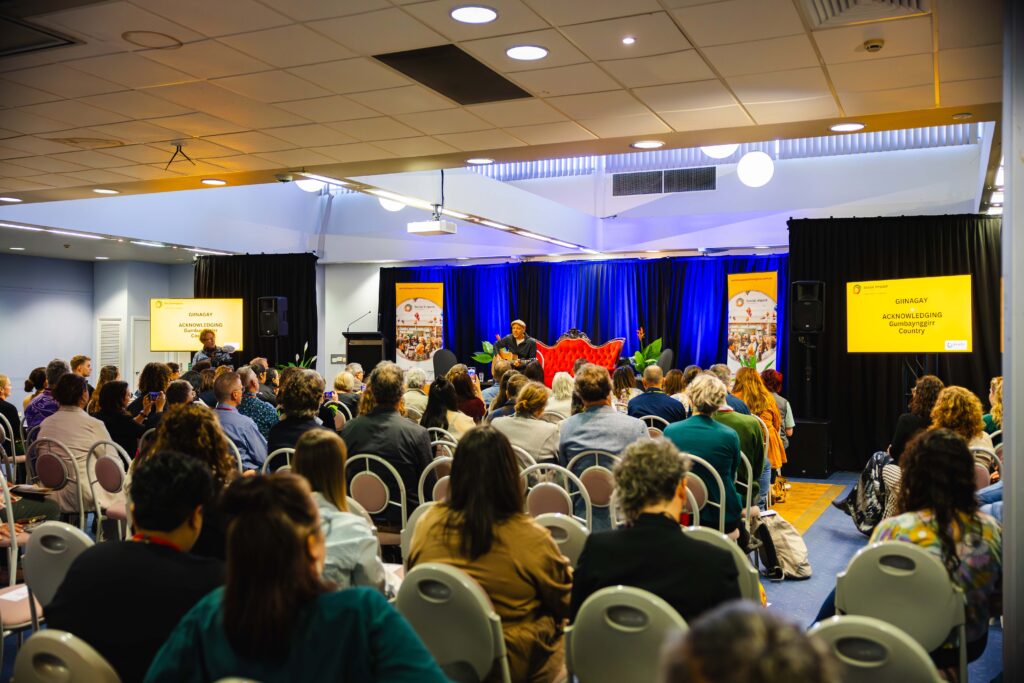
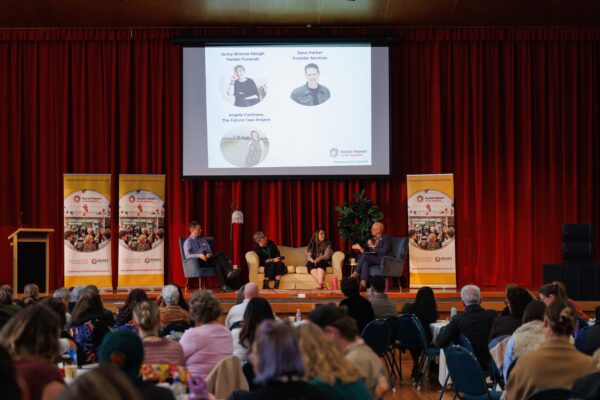
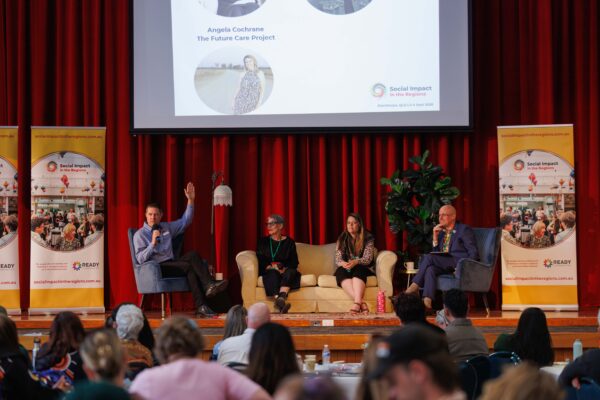
Day 1 of the Social Impact in the Regions conference continued the story of the system with a second panel, moving from funders to practitioners. The panel included Jenny Briscoe-Hough from Tender Funerals, Angela Cochrane from the Future Care Project, and Dave Parker from Frontier Services, again facilitated by Benny Callaghan.
On the models
Dave explained how Frontier Services operates as a cost centre that raises its own funds, sharing the two parts of the model. Bush chaplains cover large geographic areas and average around 50,000 kilometres a year, “finding out where there’s need and how we can best support people”. The Outback Links volunteer program is about finding the need and people registering, saying, ‘hey, we could do with some help in our community, or on our property, or whatever that might look like'”, then matching that with volunteers who travel and help, either one-on-one or in groups of around fifteen. As an agency of the Uniting Church in Australia, the funding comes from member giving, broader philanthropy and a limited amount of government grant funding, with the grant process bringing its own requirements: “There’s a lot of hoops you’ve got to jump through, but appropriately so.” Chaplains, office staff and volunteer coordinators are paid, while volunteers are often retired or travelling the country.
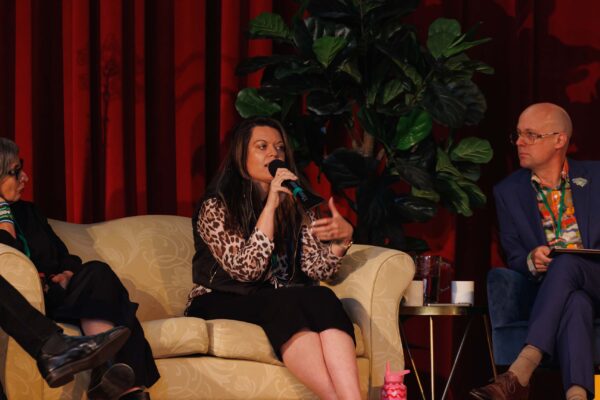
Models vary based on the stage of the enterprise. Angela shared about a dual structure two years in, with a not-for-profit limited by guarantee alongside a company that moves to a social enterprise model after revenue generation. She has adapted a twenty-year operational management background into programs that councils see value in, including action forums and childcare supply and demand surveys with seven councils in Central West Queensland that now cover some basic expenses, along with digital products connecting educators and families in communities without long day care. Angela also highlighted the value of in-kind contribution and the introductions that come with it: “Some of the most valuable experiences I’ve had through this journey so far are one-off connections that open up pathways I didn’t even know were available.”
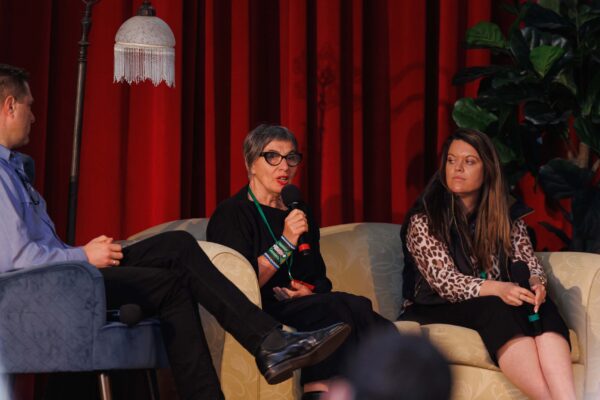
Replicating a model in other communities brings structural requirements. Jenny shared about seventeen years of Tender Funerals and the decision to say no to communities wanting to replicate the model until it had been proven: “We have had to invent everything as we go. Luckily we don’t know what we don’t know, and then we just do it anyway.” Four years on, working with Social Ventures Australia, the model became a franchise rather than a simple licence. The business model is to charge what it costs to operate and to pay funeral directors above award, using the franchising code with a social framework and dual accountability between franchisees and the national body. The national network meets every two months online and is open to anyone: “Anybody, the volunteers, board members, employees, anybody can come, and that network supports each other around funding, around knowledge, around whatever we need.” Franchisees pay a fee, and a per-funeral charge supports the national body. Pricing runs across three tiers based on capacity to pay. Sites are operating in the Illawarra, Canberra and the Mid North Coast, with Western Australia and Geelong to follow.
On the cost
Benny raised costs in models that are not listed in a budget or an acquittal: “There’s a lot of hidden costs in volunteer hours that aren’t attributed, and so we just don’t understand the full human impact of the work that we do.”
For Frontier Services, the volunteer workforce is sustained through other employment or through retirement. Dave described a recruitment drive where one prospective volunteer wrote in saying, “I’d love to come and volunteer. Here’s where we’re coming down, through the middle of the country. Where can you put us to work tomorrow?” While they may not be that organised, the engagement reflects the enthusiasm.
Jenny addressed the position of the founder, describing it as one of the issues social enterprise faces: “There is so much volunteer work done. It is never recouped at the end, and no value is given to it. We have to be really mindful of how we’re talking to our young people coming up about what it means to start something.” Tender Funerals started out of hard work, philanthropic funding, impact investment and volunteering over seventeen years: “We have done everything, we’ve done it for 17 years, and we’re still doing it. But those early years are never going to be recouped.”
Jenny raised it as a sustainability issue: “We might be doing charitable work, but we are not charities. We’ve got families, we’ve got mortgages. I’m not saying it because I want people to feel sorry. I’m saying it because we’re talking about sustainability. That is not sustainable, and many great ideas don’t happen because people have to bring up their children and pay their mortgages.” She questioned the conditions that select for who can do this work: “You have to be a particular stubborn, and in some cases furious human to do it, and maybe that’s not okay. Maybe we need to value that differently.”
Jenny also pointed to a structural strength in the not-for-profit form: “Not-for-profits are the most long-term, sustainable business models because they’re not for sale. Their succession planning is built in. They’re not going to change their mission because they’re not for sale.”
Benny drew a parallel to commercial business, where profits are reinvested for growth, except with not-for-profits there is no future payday. The sacrifice extends beyond current wages to superannuation, lost prime earning years, and whether people working in social impact can retire.
Angela described facilitating her first roundtable at 37 weeks pregnant, working through statistics on productivity and economic impact in a region with a two-year waitlist and more than 200 families waiting for care: “I remember sitting there in a room full of people talking about statistics, talking about the impact on the economy, and I also knew what that meant for me and my family.” Decisions to continue the business are tied up in an awareness that the local families they support are going to be trapped in a situation where they can’t have the economic security for themselves.
The scope of the problem is why she keeps going: “Everything in our societies, particularly in rural communities right now, is hedged on whether or not we can access childcare, and that is women’s economic security, right through to educational outcomes for our children, through to regional resilience. There is not a part of our society that’s not touched by this.”
On funding cycles, Jenny highlighted challenges with support that has been generous and hard to secure, following a common pattern of support ending before an organisation is ready: “There is a thing that happens after four years, which is called falling off the cliff. It’s cruel and unkind to give somebody funding for four years and then say take it away, because falling off the cliff is heartbreaking.” Her proposal is a longer relationship with the organisation investing alongside the funder: “We need to be given that power and that trust, and also to have a seven-year relationship based on milestones, based on business plans. I can give you business plans. I can give you feasibility studies. I can give you impact reports.”
Jenny also described the conversation she has with communities who come to her wanting to start their own: “I spend three hours when they come to me trying to talk them out of it. Not because I don’t want them to do it, but because I have to be clear that it’s a really hard thing to do and I don’t want to break their hearts or for them to be exhausted.” Communities go ahead regardless, and there are several in development around the country.
On changing the rules
Benny introduced the closing question with a story about a game of Monopoly, where the group added a social impact fund to the middle of the board and left every other rule unchanged. Players contributed to the fund and drew on it when they could not pay their rent, and everyone stayed in the game to the end: “One rule change in the system can make a big difference.”
Angela would change how funding is assessed for start-up social enterprises. Organisations of this kind exist because someone identified a gap and stepped into it, which means the problem and the proposed solution rarely match an existing category: “We’re filling a gap in the market that exists, and we’ve come into it with a particular set of lived experiences and a unique set of circumstances that have brought us to this awareness as to why the problem persists. I don’t fit neatly into that box because the problem I’m trying to solve hasn’t been talked about or assessed.” She described a community cabinet conversation where the first question from a minister was to ask who did her modelling: “I said no one, because I’m paying my way, and I can’t produce that for you now. I’m not saying I’m not aware that has to be done, but I have to have the funding and the tools available to me to do that.” Her advocacy has moved things regardless. A minister’s office contacted her two weeks before the conference to say her work was foundational to a Senate inquiry into regional and remote childcare access: “Advocacy does work if you beat the drum long enough, if you are persistent, if you are the squeaky wheel.”
Dave would change the requirement for separate volunteer checks in every state. He supports working with children checks and police checks as due diligence for the work Frontier Services does: “Working with children rules are important to us. And I have no problems with that rule. I do have a problem with the rule that it has to be different in every state.” A volunteer with a New South Wales check who travels north needs a blue card. Dave went through the process himself as a board member of a Queensland organisation, which took five weeks: “We lose volunteers because of that complexity. We have volunteers who say, it’s too hard.”
Jenny answered by questioning the premise of the question, crediting a former chief executive of a major not for profit: “There’s no such thing as a broken system. Systems deliver exactly what they’ve been designed to deliver. You can’t fix that system. It needs to be redesigned.”
A bold conversation
Benny closed the panel by asking each speaker for a bold conversation the sector needs to have.
Jenny raised two: “I would like everybody to go and talk to everybody they know about the fact that no First Nations person should ever have to pay to be buried in this country. That should not happen. Keep saying that to everybody we know, and eventually that will happen.” The second related to funded end-of-life carers’ leave: “Most people doing end-of-life caring are women. They leave their jobs. They don’t get jobs after they’ve done that care, and the care responsibility belongs to all of us. Let’s not make that always have to be family. That can be your best friends.”
Angela extended the same recognition to those caring for children. On Early Childhood Educators Day she recognised “a female-driven industry that is one of the most qualified yet worst paid still to this day”, and asked for equal recognition of the parents who stay home: “If you want to be at home raising your children, whether that’s mum or dad, that’s something we need to make sure families have the capacity to do. It’s unseen, invisible, unrecognised, unpaid labour that supports our wider economy.” She pointed to centres and large providers closing and to the absence of any conversation about who absorbs that cost: “No one’s asking who’s absorbing that. How many small businesses are not able to run because that parent has had to leave?”
Dave’s was for organisations to say that they do not have all the answers: “We don’t achieve everything that we’re seeking to achieve. How can we do that better? In partnership with others. That’s a great opportunity for all of us in this room to be able to connect and network and have those conversations.”
If you were in the room for this panel, I am keen to hear your reflections.
Delegate feedback
“I particularly appreciated the ‘on the ground’ session. It was refreshing to hear the challenges of the work openly discussed – and think there should be more of this. Whose free labour does it stem from (what is their gender) and what are the longer term impacts for them, including from failed ventures?”
“Having so many funders in the space getting to hear from the community.”
“The vibe in the room was awesome and authentic”
“i enjoyed the panel discussions the most.”