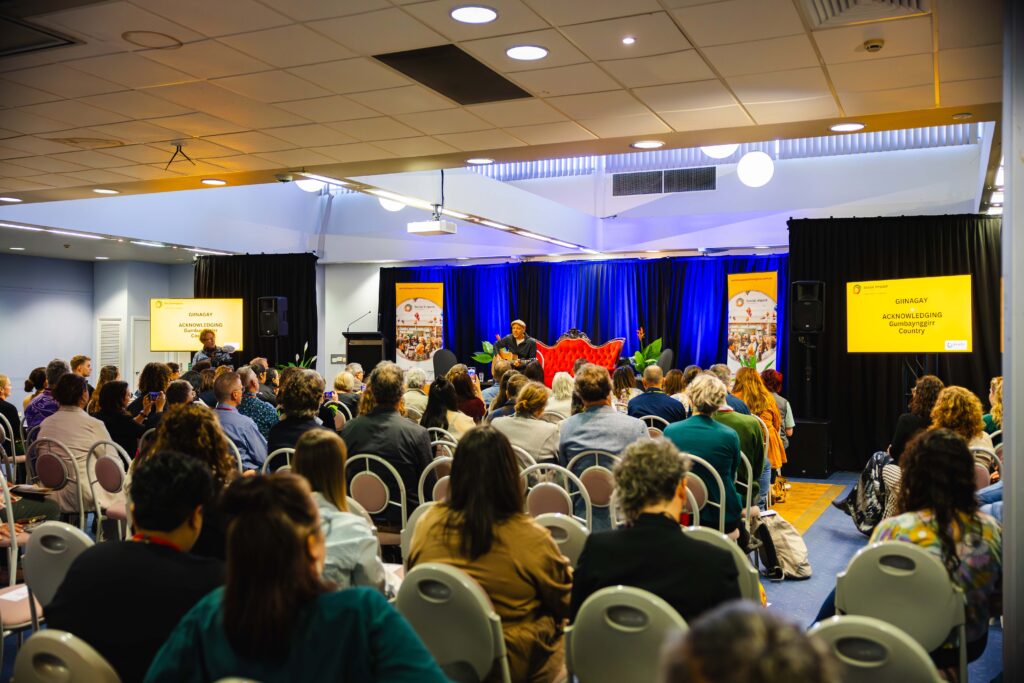
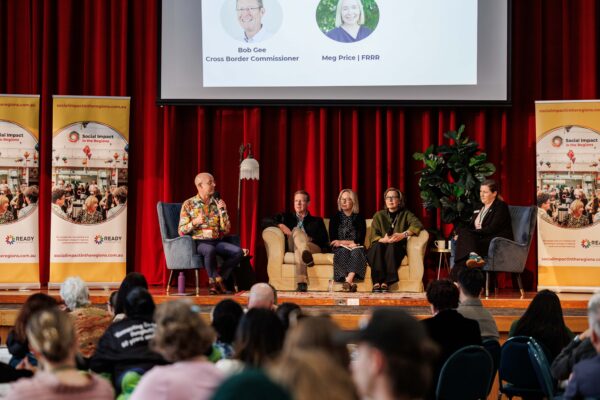
Day 1 of the Social Impact in the Regions conference opens with setting the scene of a system in transition, with the panel including Fiona Maxwell, CEO, John Villiers Trust, Meg Price, Head of Rural Horizons, FRRR, MJ Bellotti, Chief Executive Community, RACQ, and Bob Gee, Cross-Border Commissioner, Queensland Government.
Facilitator Benny Callaghan set the scene, saying, “I don’t talk about systems change anymore because I find it disempowering. I talk about systems connectivity, because that’s where we can find agency… We are all part of the system.”
On roles and alignment
The funding system means there are many requests for a low number of funds. Fiona shared about the effort required by those pursuing over-subscribed funding rounds and the need to move to invitation-based funding: “The most important piece for us is about what your community wants and leading from there.” There is a further push towards untied funds for as many years as possible, placing the trust in the hands of the community, and letting the community decide.
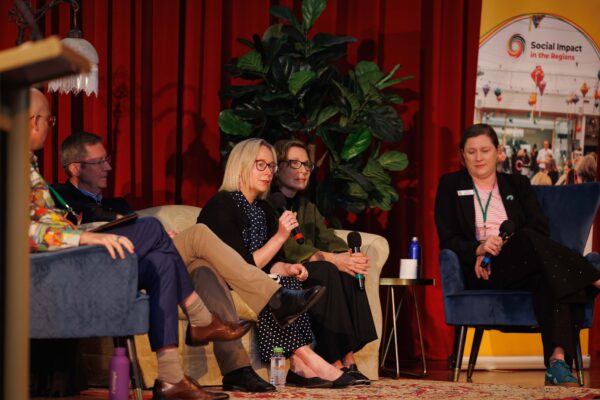
Meg reflected on the importance of clarity of roles by those making change in communities, with FRRR programs designed to be catalytic and avoid creating dependency or taking on service provision: “There are many different roles in the system. All of them are necessary. They are interdependent, and we need each other – we work best when there is deep listening and power is shared. It’s bringing together a group where you’re going to play different roles in the system or in the lifecycle of change.”
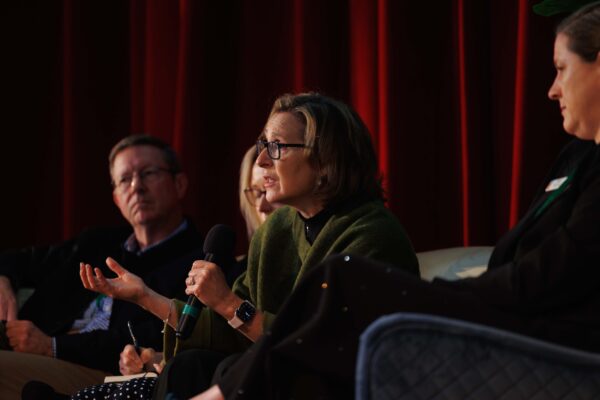
MJ shared about matching funder priorities and recipient capability. RACQ’s board committed a $1 million capital grant and 20% of annual profits to community work across solar and batteries, public EV charging, road safety and volunteering. The organisations play a role in being prepared to be fundable. RACQ looks for those prepared to play a critical role in a community’s disaster resilience and engage in a due diligence process with organisational brand representation and sustainability.
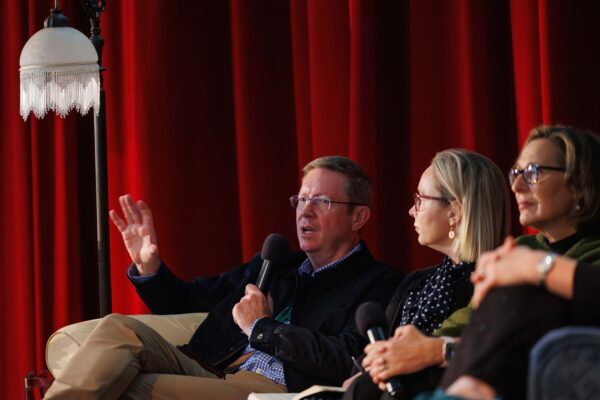
The facilitation role is important in this matching. Bob reflected on a tension of scalable programs in a context of localised wealth and rural service gaps – “there needs to be more honesty and competence around how we facilitate government philanthropy so we can do the micro and the macro.” He spoke of the current global reorganisation, which is prompting the question, “How do we maintain trust in the institutions, philanthropy, government, and trade? Our economy is changing… You should demand of people like me and say, ‘We need you to facilitate what we want to do on a micro level, connect us, and learn or partner with others so that we can become more sustainable.’
On sustainability
The conversation continued with questions of sustainability, asking what it looked like from a funder’s perspective.
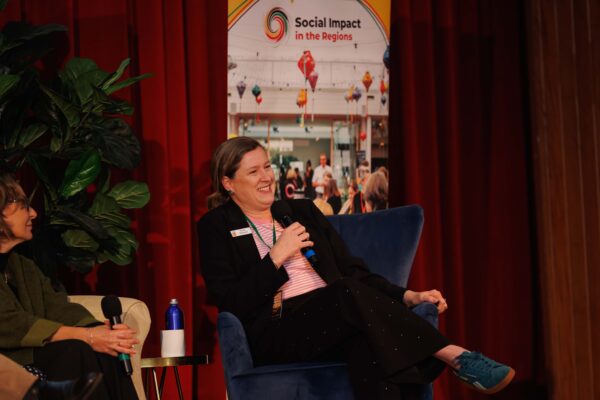
Fiona highlighted how fields such as arts, domestic violence, and food relief do not have a way to be sustainable without some kind of support. But the system is hindered by a lack of feedback and resistance by funded organisations to share with funders where something has not worked. This needs to be addressed through closer relationships with funders and more open conversations: “If we keep iterating and co-designing together, then we can find things that might last a bit longer.”
Part of the path to sustainability is to expand perspectives to challenges. MJ gave the example of the Salvation Army’s Drive to Life program that goes beyond driving training: “It’s not just about the driver. It’s the wraparound services that go with that individual, who’s often vulnerable, and they need other support. It’s looking for organisations who have the ability to grow, have the model, but they might be lacking the funding to get there.”
Meg’s response to the sustainability challenge focused on building capability, capacity, connections, and advocacy beyond funding, with the funder playing a role in strategy work to improve internal systems and sending leaders to conferences like Social Impact in the Regions. “It’s seeking to build the capability of the organisations and the leaders for the amount of change in their field, rather than the one-off grant funding for projects.”
This role changes by organisation and over time. “The role might shift from funder to connector, to partner, to advocate. A large part of our role is seeking to be an injection of funding, but then also a catalyst for things to take off. It might be introducing other funders as maturity grows with an organisation. It might be joining up advocacy and influencing to build up the community voice to shift policies.”
The conversation highlighted a tension between long-term policy change and immediate sustainability of smaller change makers. Meg raised the example of the recent DGR status for community foundations, “Some of these things take a really long time. For example, community foundations have just undergone a big change to their tax status. But that has taken twenty years of mobilising and community voice to bring about that shift and that change. Things like that are worth the time and effort because it helps individual community foundations to be more self-sufficient and financially secure. Sustainability isn’t a short-term fix. It’s saying we are here for the long term. Our role and who we are to you might shift and change as your needs shift and change.”
On transition
With the theme of the conference being “Regions in transition”, the panel explored what that meant in concept and practice.
Meg considered what transition feels like from the philanthropy side, noting a dual pressure to work with urgency while also slowing down and doing change. Transition is also about financial sustainability to ensure funders will be here for the long term to continue to walk alongside rural and remote communities. In a changing landscape, this requires funders to transform their business and make sure they are operationally and financially fit. Meg brought this down to the individual level, noting the staff in funding organisations are often rural and remote and regional staff members, navigating things in their own lives, wearing multiple hats and involved in not-for-profits – “how to care for our own people during transition is not mutually exclusive”. Meg shared how they find themselves being a translator, talking to other funders and government to be that voice of community, bringing community voice into the conversation, and translating policy and systems and funding to community. “Investing in relationships is crucial and constant in our work. Philanthropy as a sector is undergoing transition. That looks like turning the mirror on ourselves.”
Meg highlighted a careful consideration in transition: wealth extraction and power hoarding. This involves honestly questioning the systems that led to large amounts of wealth, and the justice and decolonisation necessary to ensure we are not perpetuating the issue through decisions we make and how we go about funding. “That looks like leaning into participatory grantmaking and giving decision-making about where funding goes to community rather than that sitting at our board level.” Meg highlighted how this transition requires readiness and capability building not only at the community level but also at the government and funder level. “In this big transition – the call for power shifting for governments and funders to shift to community-led – it needs philanthropy and government to be ready. We can’t assume that we have those skills. That’s a core investment we need to make to have the ability to shift power to shift decision making.”
Fiona added to the conversation about the need for new forms of funding. The example was raised from the Office of Social Impact launching a program around loans, where philanthropy is chipping in towards loans, governments coming to the party, and loans going towards the capability building of social enterprises. “If we can invest that money for impact, that’s how we can put more capital into the whole system.”
MJ reflected on the power of the collective voice and agency in transition, using the example of federal policy change reducing funding for critical road infrastructure. The response was not just RACQ, but a collective of industry bodies and media. “We had a hard constraint out of our control, which was the policy of the day changed. We learned through that process the value when you rally the voices of a coalition of people that represent broad parts of the economy.”
Bob emphasised what needed to be done for better advocacy, sharing that communities needed to “have a plan, understand the problem or the opportunity, know the numbers, understand to the point just made that you have so much power.” The collective power of community, particularly the economic and social groups, to come together, form better coalitions, and get more done. The concept of mutual benefit for those around the table is key, noting that “Trust comes from not just being open, but showing competency and getting numbers on the plan.”
Delegate feedback
“Such amazing facilitators throughout the day – they pulled together so much depth of knowledge and variety in perspectives, which just left me wanting more! So good to have all of this out there to reflect on.”
“Great start to the conference. Good energy and engagement. Great framing to the discussions and for the broader event to come”
“Day 1 was excellent, really set the scene for the event.”
“I loved the panels!”
“Really enjoyed the content. Great start!”