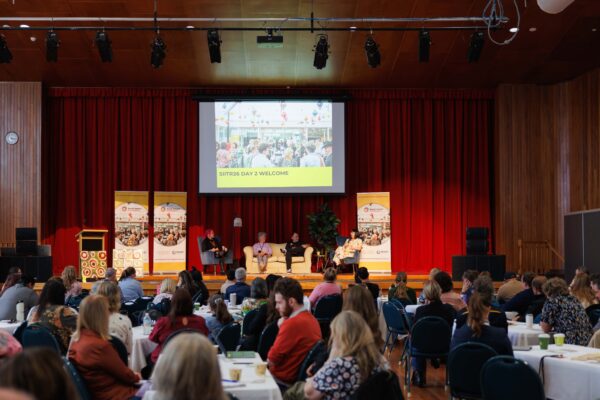
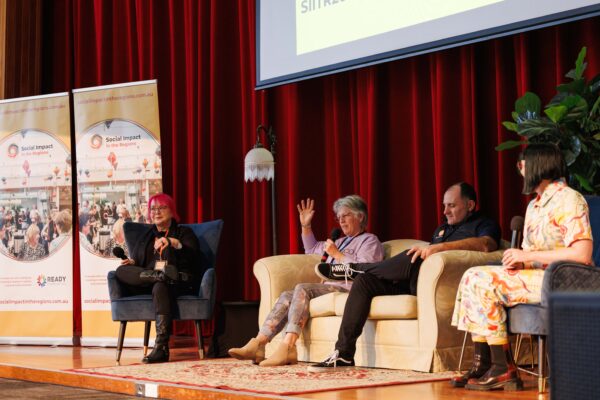
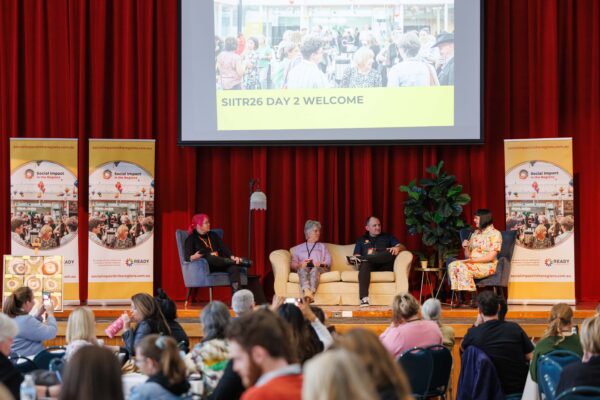
Day 2 of the Social Impact in the Regions conference opened on the theme of transaction to transformation, with a panel on what it takes for sustained change in regional communities. The panel included Claire Torkington from Ability Enterprises, Christelle Withers-Mayne from Graham House, and Ashley Watt from Why Leave Town, facilitated by Zoe Eather.
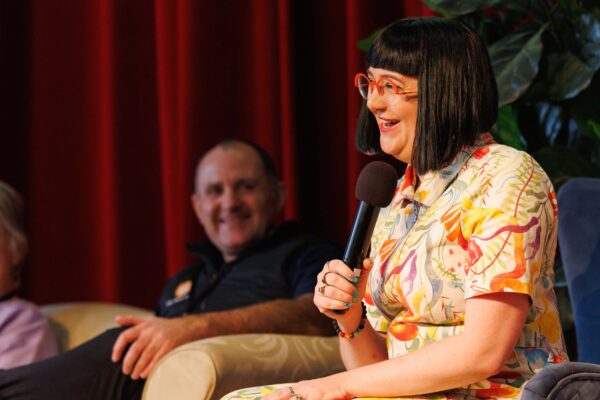
Zoe set the frame for change, saying: “It doesn’t happen by magic. It happens by real people doing real things on the ground.”
On the enterprises
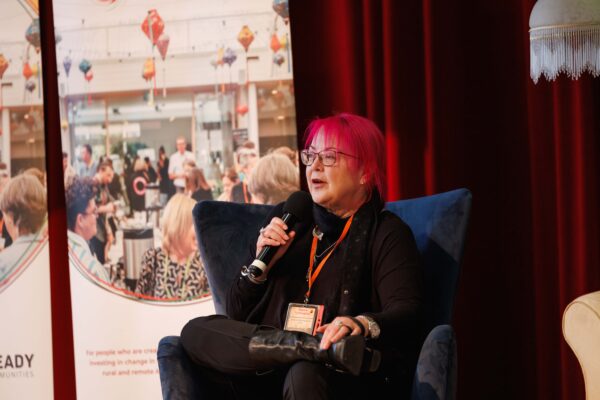
Claire described herself as “the accidental CEO of a social enterprise called Ability Enterprises”. Based in Toowoomba, it delivers waste facility services, cleaning and gardening, employs 100 people, and now covers its operating costs through trade. She took over three years ago and, after concerns in the first 18 months, the organisation now holds contracts with Toowoomba and Lockyer Valley regional councils with a seven- to nine-year runway.
Claire continued to describe those ‘supported’ by their services. “We’re not supported employment. We call ourselves employment with support.” The cohort includes people with physical disability, people with lived experience of poor mental health, Indigenous Australians and refugees, and what Claire calls the missing middle: “A lot of our cohort are not disabled enough to be fully on the NDIS or funded by the more high support services, but they’re never going to make it in open employment.” Between 20 and 30 per cent transition into open employment each year, and the rest can stay: “We’re also not a throughput model. My most mature employee, who’s been with the organisation a lot longer than me, is 83.”
Christelle shared how she started as a registered psychologist, spent about ten years in child safety, and took on the CEO role at Graham House seven years ago. The centre runs around fourteen programs, including a transport program with 16 vehicles and 45 to 50 volunteer drivers, which exists because there are almost no medical services in the region and no public transport.
While still in her main role, Christelle shared about a side project GH Clothing Co that came out of a board meeting after Target left town in 2021. A board member said he could no longer buy a pair of jocks in town, and Christelle answered off the cuff that they should open a clothing store: “The board looked at me. And they said, why don’t you investigate that?” She talked to every other retailer first: “I made sure that they understood that we would not compete in any way, and they were actually really worried that Target was leaving too, because this was going to affect the whole business economy.” People had been driving 50 to 100 kilometres to Kingaroy for clothes, and doing their groceries, fuel and pet supplies while they were there.
Christelle highlighted the reality of many social enterprises where intent for profit redistribution does not always match commercial pressures: “It would be lovely to be able to say we’re making a profit, and those profits all go back into the community. We haven’t yet achieved that, so we’re not breaking even. if you consider that we have to pay wages. If we didn’t have to pay wages, we would be doing reasonably well.”
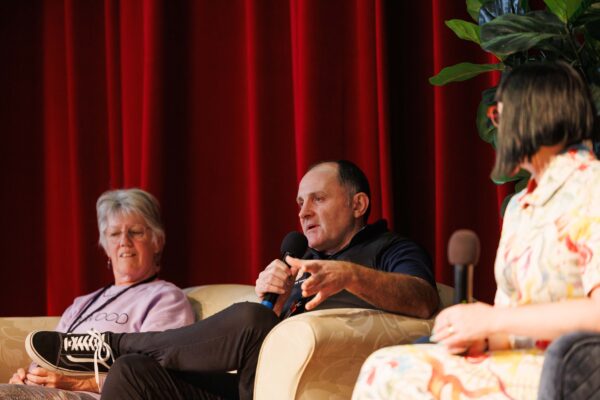
Ash shared how he spent fifteen years as a corporate market researcher running quantitative work with large supermarkets, from Sydney, then Adelaide, then back to Narrabri: “So I went from a nice corporate wage to basically nothing for a couple of years.” Before going full-time he researched the shop local question with more than a hundred interviews with councils, traders and business owners, and wrote a book on what he found. The business landed on a gift card program that locks spending into a defined local economy: “We make sure every time one gets purchased, the money goes straight back into local economies.”
On the challenges
When the panel then turned to challenges, Claire opened by talking about setting up long-term infrastructure for short-term contracts. “Like many social enterprises, some of the major challenges for us have been around short contracts, having to set up infrastructure and the business to deliver something when you don’t know how long that’s going to last.” The solution was not how to manage short-termcontracts, but to avoid them altogether: “That’s been one of the things that we’ve focused on in terms of trying to get some longer contracts, which we fortunately managed to do. When I say our business now funds all of our operations, I don’t want people to think that we don’t ever take grants, because we do, but we are now lucky enough to take them only in relation to capacity or capability building for the organisation.”
A second challenge Claire raised highlights issues unique to employment-related social enterprises – the mixed nature of a workforce in a social enterprise providing employment for individuals that fall outside traditional employment models. “The psychosocial hazard legislation is a major example and challenge for us. In a team of 100 people, you might have five percent – five people – who pose something of a psychosocial hazard. [In my workforce], I’ve deliberately honed in on 90 of them. It’s balancing the mission to support these people to remain in work with the legislation to protect everybody else from any form of psychosocial hazard.”
Christelle raised the issue of money, but in the context of needing money for skilled management, which even then was not readily available in regional communities. “Money is a big one. A business like this needs to be self-supporting. We’re fortunate that Graham House had some funding that they could put into it. To be self-supporting, we need a manager who knows what they’re doing in retail and can make the business profitable. Because we’re in such a small area, the pool of shopkeepers when we first started off was quite small. None of us knew what we were doing. We’re probably all fairly good at shopping, but none of us knew how to run a shop. Over the years, we’ve been able to recruit and give jobs to a number of people, including long-term unemployed individuals, young people, and one or two volunteers helping in the community. That’s been really great. But they come with all their challenges too. It’s been an interesting journey.”
Ash raised three challenges, starting with a technology-driven approach engaging small regional businesses. “Keeping up to date with technology and implementing the system when we work with small regional businesses. It’s a very difficult market to work with, mainly because they’re out there busy running their small business. There are a lot of things that you can put there, but if it’s not easy to implement, then they just won’t cross that barrier.” In addition to trust, technology also has the inherent challenge of building on a constantly changing environment: “At times we are ready to push hard with what we’ve got, everything’s ready to go, and we’re going to mass sell to the world. Then the next tech issue comes along and pushes us back a couple of years and thousands of dollars. But then we’re stronger than before.”
The second challenge was a general scepticism to change. “We found that many small regional businesses can be quite sceptical. They like to sit on the fence whenever anything new is coming about. It’s possibly just the world we live in that there are people who take advantage in different ways. People become sceptical about what’s in it for you, how you’re making money, and how you’re going to rip them off. Particularly when we go into a new region where we are not known, people think you’re there for bad rather than good.” The response to the challenge was to engage local trusted entities to bridge what Ash referred to as the ‘trust gap’: “We connect with the local council, local chamber of commerce, and so forth to bridge the trust gap. Spending time and building those relationships right is so important. It’s about selling the trust of what we’ve done in other places and who we are. Particularly as a small business, if you want that trust, you’ve got to put yourself out there. That’s something that I’ve worked on over the last twenty years. Make sure people can see you, because they need to be able to trust you.”
The third challenge Ash raised was money, but from the perspective of adding pressure to small businesses as part of the value chain. “When we sell our product, we find that as prices increase, everyone takes a piece of the pie. Everyone who’s an operator can understand that different fees and groups need to be involved to produce and sell something. What you end up with as a business owner is very small. We are always trying to reduce costs for our customers and our clients, while also having a product that benefits their businesses. It’s very hard to charge businesses.” The strategy Ash has learned is to develop collaborative support structures so cost pressures are better distributed. “We go at the macro level and work with the local council and chamber. The person who is getting the end result is not the one paying for it.”
On adapting
Continuing the conversation on creative adaptation, Claire described their approach to their employee assistance program (EAP). “It’s been a case of looking at things differently in terms of place-based and growing the sector in Toowoomba. I realised that the traditional EAP model doesn’t suit our team. There was no EAP provider in Toowoomba – they’re mostly Sydney, Melbourne, or Brisbane. We looked around and found Adapt Mentorship, a local non-profit and Indigenous-owned business with psychologists and social workers. We met and said, ‘Look, this is what an EAP does. Can you guys do that?’ We then diverted the funding for our EAP to them. Now they visit our sites; they’re hyper-locally connected, and they access other services for people. We also learned that, with our team, when they stop coming to work, it’s never about the job. It might be that this week something has happened where they need to choose between food and fuel. So in real life with the EAP, they can just tell Adapt that that’s their situation this week, and we will email them a fuel card so that they can just anonymously fill up their car and can keep coming to work.”
Ash highlighted how adaptation is complicated when there are many possible paths to navigate a constantly changing environment with unique complexities of the social impact space. “You’ve got to look for the low-hanging fruit to start with. What can we actually implement today? So at least you can start. If you start too big, the year gets stuck for the next twelve months trying to get something off the ground. I like to start with something simple and then build from there.”
Another consideration with adaptation is that each approach requires unique capability and capacity. A strength or success in one domain does not necessarily translate to another as Christelle discovered when developing GH Clothing from an experience with Graham House. “In our small community, Graham House does the normal kind of neighbourhood-centric things. Driven by community needs, one of our biggest programs is a transport program. We run 16 vehicles with 45 or 50 volunteer drivers because we have no medical services to speak of in the South Burnett and no public transport. Most of our clients are aged, so they don’t drive anymore. That was responding to a community need that was identified. When GH Clothing came along, we identified this community need and thought we could step into that. But we’ve ended up stepping in a very different way. It’s not government-funded, whereas most of our other programs are government-funded. We have to learn to navigate this whole commercial retail space. As psychologists and social workers, none of us has that expertise. But I can say that the community appreciates it. Our customers often tell us how good it is to be able to just come into town and buy what they need.”
While the team developed the retail capability, another challenge was community perception and clarity of the business model. “Graham House is a neighbourhood centre and is seen as a charity organisation. We have also been running a thrift shop for decades, our family-to-family thrift shop. When we started GH Clothing, we had people standing outside the shop saying, ‘Don’t bother going in there; it’s all secondhand.’ But it’s taken a long time to get people to understand that no, it’s brand new clothing. This is a regular retail store that happens to be run by Graham House.”
Claire also mentioned another need for adaptation – the need to adapt from past decisions. “We had to do a very major pivot. Former management set up a warehouse operation and invested in equipment that didn’t really do what they thought it would, and the feedstock for manufacturing wasn’t suitable for the equipment. We have this equipment – a shredder, granulator, and extrusion machine. We had to think about who else uses this machine. If we can’t do the project it was intended for, what can we do? So now we’re training people in the factory, aiming to get them work-fit rather than work-ready. There are a lot of work-ready programs, but that doesn’t make people work-fit. The other pivot has been partnering with the local uni, which has PhD students doing a lot of work on plastics and other materials. We now hire our machinery for them to use as another way of using the facility.”
While a conversation about adaptation and pivots can sound planned from the comfort of a conference panel, Ash highlighted the practical reality. “The thing for our business is it’s possibly been about 75% forced pivoting and 25% where we go, okay, we want to push into this other area, we want to do something new. Most of the time, it’s in response to a barrier that we’ve got to overcome.”
On the ecosystem
The conversation then moved to the ecosystem of support and those the panel worked with in their communities. Ash opened by explaining the ecosystem for shop local cards. “When we go into a community, we work with the local chamber of commerce or the council. Ideally, a combination of both. To grow our programs, we look at other organisations within the community we can partner with like Lions Club, Apex, Rotary, and so forth. They’re the ones who are doing fundraising. We can be the channel for how they direct funds back into the community. We’re constantly looking for organisations like that to work with. When we’re looking to overcome our challenges, we look at who else we can collaborate with. Talking about the credit card stuff, we’re talking with payment providers about how we can help them in what they’re trying to do and how they can assist us in what we’re trying to do. The more we grow that, the stronger we become as a business.”
Claire’s story highlighted the system’s tendency toward scarcity, which then requires intentional intervention toward abundance. “It’s also about looking for opportunities and ways you can get a social enterprise network where we can collaborate. Even things like sharing spaces or taking an abundance mentality. We recently had a philanthropist who approached the three larger social enterprises with a fund aimed at supporting graduates around employment or education. The three of us had a chat, went back to them, and said, ‘That’s a great offer, but would you be willing for us to put in an application that extends that to every social enterprise?’ [One social enterprise] wanted to do the development program, so can we use that money for a leadership development program, and then open it up to the centre so that a leader from every one of those could attend. That’s what’s ended up happening, which is wonderful.”
Christelle expanded on the realities of competition in the smaller markets of regional communities. “To be true to our values, we don’t want to compete with other businesses in town. It’s clear with the elements of businesses from the start that we weren’t going to be in competition. We’re trying to work with them to make these business economies stronger, and that’s worked to a good degree. The suppliers of lines help to a degree because they won’t supply to every single business in an area. Yet, trying to establish collaborative relationships in a business environment is trickier than in the not-for-profit environment.”