Join us in supporting Aunty Maria De Vries to kick off a social enterprise Aboriginal Corporation which will produce textiles inspired by the artwork of Aunty Maria and other first nations artists in the Granite Belt.
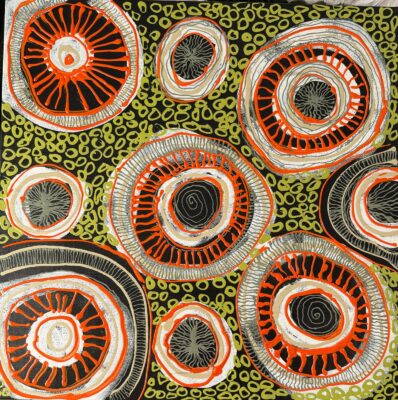
Leading into SIITR26 Ready Communities commissioned Aunty Maria De Vries to create an artwork which related to the National Regional Challenge theme, ‘cultural practices’, tell us how your region shares a story that belongs to everyone.
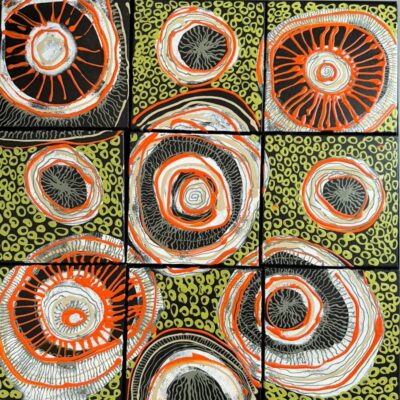
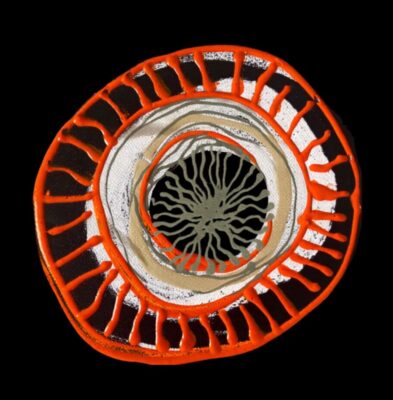
Aunty Maria produced not one, but ten artworks with the title ‘Same same, different mob’. And this year SIITR26 delegates will have the opportunity to participate in a silent auction to purchase one, or several of the works.
Painted with acrylic on canvas the works are showcased in two different contexts. The first, a series of nine separate paintings which Aunty Maria hopes will be purchased by people all across the country creating ties across the nation. The second, a similar image on one canvas.
Think these will inspire your space? You’ll be able to make your bid at SIITR26. Or get in touch if you’d like to make a bid and can’t be at the auction. As you consider your bid keep in mind your contribution will go towards things like sewing machines, ink, fabric, tuition, rent etc. And keep an eye on our blog for more details as the enterprise emerges. Want to grab something you can wear now? Read on…
\
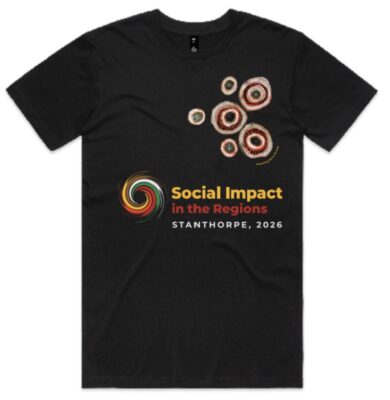
This year we have created our first, limited edition SIITR26 T-shirts featuring Aunty Maria’s painting. You can order your t-shirt here: Social Impact in the Regions 2026 | Social Impact In The Regions – Conference and collect it at the conference. All profits from the t-shirts will also go to the emerging social enterprise.
We share our gratitude to Aunty Maria for the time, connections and kindness she’s shared during our time in Stanthorpe.
Aunty Maria De Vries is a Gamilaroi/Gamilaraay artist and designer whose creative practice spans more than four decades of artmaking, community work and First Nations cultural projects.
Born in Scone, New South Wales, Maria studied at Wollotuka in Newcastle in the early 1990s before establishing herself in Queensland’s Granite Belt, where she has become a respected artist, community organiser and advocate for First Nations arts and culture. Her early practice centred on painting and lino printing, with her work appearing in Gatherings II, a publication documenting Queensland First Nations artists in the early 2000s. Her designs have also travelled beyond the gallery through early collaborations with Mambo, musicians and other artists.
When arthritis made the physical process of lino printing increasingly difficult, Maria adapted rather than stopped making. Over the following years she developed a distinctive multidisciplinary practice across painting, textiles, wood and functional objects. Her intricate pattern work now appears across canvases, woven earrings, painted wooden bowls and other handmade pieces, moving fluidly between fine art, design, craft and objects intended to be lived with.
Maria’s work has been exhibited across regional and community galleries, including Stanthorpe Regional Art Gallery and Muswellbrook Regional Arts Centre, as well as numerous community exhibitions. She has received multiple awards in the Indigenous Artist category of the Stanthorpe Local Art Prize and has been selected as a finalist in the national Stanthorpe Art Prize.
This evolution has opened a new chapter in Maria’s practice: translating her growing body of patterns and designs into garments, textiles and collaborative collections. The development of a dedicated fashion label will give Maria the opportunity to build an enduring platform for her work, explore partnerships with designers, manufacturers and other labels, and allow her designs to exist beyond individual artworks and reach new audiences.
Maria’s creative life has always been closely connected to community. For around 30 years she has helped organise and deliver community arts initiatives and First Nations projects throughout the Granite Belt. She has served on the board of the Awesome Black Foundation from 2020 to 2026, contributing her experience and community perspective to its work supporting First Nations creativity. In 2026, her contribution to the region was recognised when she was named Southern Downs Cultural Citizen of the Year.
A mother of four who also spent many years fostering and caring for children, Maria has built her artistic practice alongside a lifetime of caring for family and community. She now works from her studio on a property outside Ballandean, continuing to develop a visual language that has grown and changed with her over decades.
Maria is entering a new chapter in her practice, translating the patterns, motifs and designs she has developed over decades into garments, textiles and collaborative collections. The establishment of her own fashion label will create a platform for this body of work to grow — opening opportunities for partnerships with designers, manufacturers and other labels, and allowing her work to move beyond individual artworks into pieces that can be worn, used and carried into everyday life.